How Does Air Resistance Affect a Falling Object
At first the object will have a high acceleration but as it speeds up it will experience more drag. This experimentally determined fact is unexpected because we are so accustomed to the effects of air resistance.
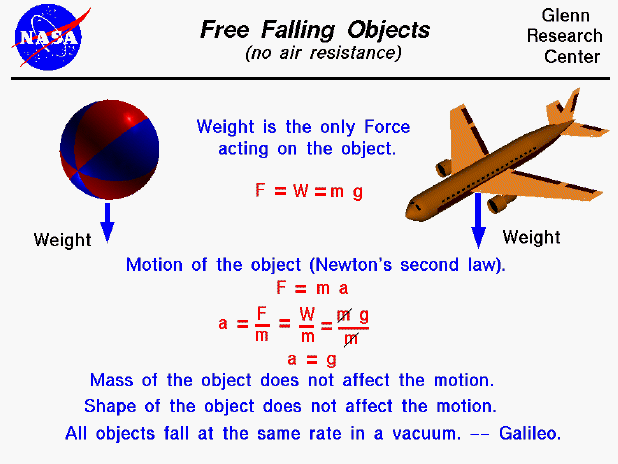
Free Falling Object
While gravity pulls the object down we find that air resistance is.
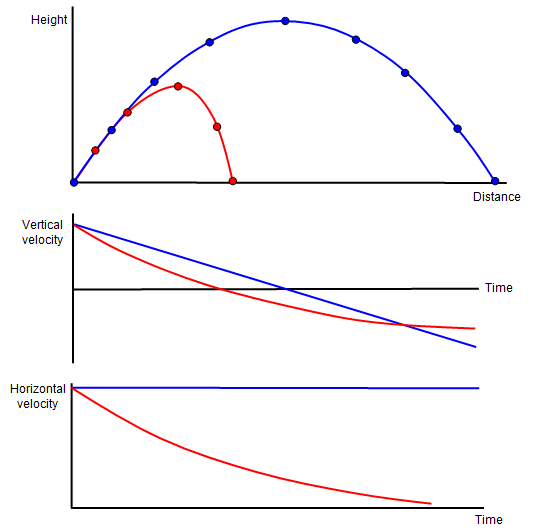
. An object that is falling through the atmosphere is subjected to two external forces. The faster you move the greater the resistance. But in the atmosphere the motion of a falling object is opposed by the air resistance or drag.
The force of gravity causes objects to fall toward the center of Earth. The drag equation tells us that drag D is equal to a drag coefficient Cd times one half the air density r times the velocity V squared times a reference area A on which the drag coefficient is based. Acceleration stops at the Terminal velocity.
A region where there is no air or any other gaseous quantity and therefore absolutely no air resistance. The first force is the gravitational force expressed as the weight of the object and the second force is the aerodynamic drag of the object. If the object were falling in a vacuum this would be the only force acting on the object.
The time that has passed since the beginning of an event. In the air resistance formula F12rhov2C_dA the higher the velocity the more air resistance there will be for an object. However when air resistance is present then the net force on the object changes because the force of air resistance counters the force of gravity.
Air resistance may change the direction of a falling object but does not affect its speed. When a object is falling the effect of. Air resistance works with gravity to pull a falling object towards.
Air resistance affects a flat sheet of paper more then a crumpled one. These molecules hit. Objects falling faster in the air for example skydivers cause considerable amounts of turbulence and consequently the air resistance experienced by them is much greater.
The key effect is the geometry of the object. Its shape its velocity is also important. Increasing the surface area of an object decreases its speed.
Air resistance depends on the cross-sectional area of the object which is why the effect of air resistance on a large flat-surfaced object is much greater than on a. The acceleration due to gravity is constant which means we can apply the kinematics equations to any falling object where air resistance and friction are negligible. Up to 24 cash back The amount of air resistance acting on an object depends on the size shape and speed of the object.
The net force is 0 N and the object. Air resistance depends on two important factors - the speed of the object and its surface area. A falling object directly downward is slowed down by air resistance.
Answer 1 of 6. When air resistance acts acceleration during a fall will be less than g because air resistance affects the motion of the falling objects by slowing it down. Air resistance opposes the force of gravity and causes falling objects to lose speed once they reach terminal velocity.
How does air resistance affect the acceleration of falling objects. It counteracts the force of gravity and slows the decent of the object at a rate proportional to the objects velocity. The most remarkable and unexpected fact about falling objects is that if air resistance and friction are negligible then in a given location all objects fall toward the center of Earth with the same constant acceleration independent of their mass.
In turn it would take longer to fall. Increasing the surface area of an object decreases its speed. Air resistance represents a type of air friction in which an object encounters molecules in the atmosphere.
The weight equation defines the weight W to be equal to the mass m of the object times the gravitational acceleration g. Air resistance is a frictional force that air pushes against a moving object. This opens a.
The speed and direction of an object in free fall at which the acceleration of the object becomes zero. Air resistance depends on two important factors - the speed of the object and its surface area. The upward force of air resistance continues to increase until it is equal to the downward force of gravity.
Subsequently one may also ask how does air resistance affect velocity. The acceleration of free-falling objects is therefore called the acceleration due to gravity. How to Calculate Air Resistance of a Falling Object when the Object Falls Fast in Air.
Air resistance may change the direction of a falling object but does not affect its speed. When air resistance acts acceleration during a fall will be less than g because air resistance affects the motion of the falling objects by slowing it down. As a falling object accelerates through air its speed increases and air resistance increases.
If you have two objects of the same shape and the same density and one is bigger than the other then the big. The faster the vehicle -moves the bigger the air resistance becomes. The acceleration of a falling object without air resistance is 98 ms2 because the net force acting on the falling object is equal to the force of gravity.
Air resistance also called drag acts upon a falling body by slowing the body down to the point where it stops accelerating and it falls at a constant speed known as the terminal velocity of a falling object. In normal air a bowling ball will fall much faster than a feather. Air resistance always tries to slows a moving object down.
Air resistance depends on two important factors - the speed of the object and its surface area. An example of this effect can be seen in vacuum tubes. When air resistance acts acceleration during a fall will be less than g because air resistance affects the motion of the falling objects by slowing it down.
How does air resistance affect a falling object. The amount of air resistance is not affected by the mass of the object. As a falling object accelerates through air its speed increases and air resistance increases.
It is also known as drag. However in a vacuum tube where the air resistance is 0 a vacuum reduces the density of the air to 0 which will reduce the force. What is air resistance.
For these objects the air resistance is directly proportional to the square of the objects velocity relative.

Air Resistance On Projectiles Terminal Velocity Ib Physics Youtube
Schoolphysics Welcome

When Does The Air Resistance Force Make A Difference Wired
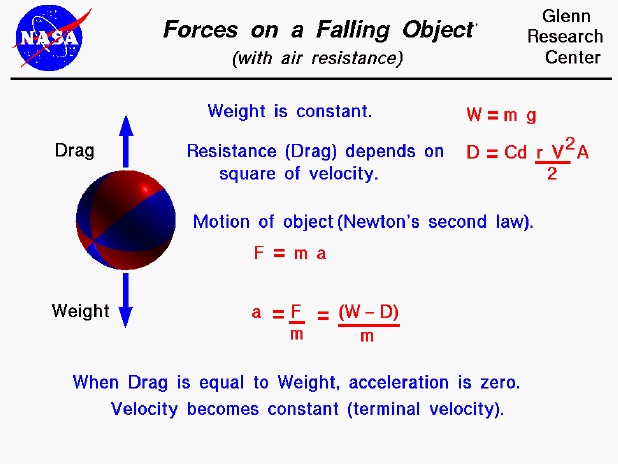
Falling Object With Air Resistance


Comments
Post a Comment